




Table of contents
Do you recognize this?
Trauma manifests itself in many ways. Many people walking around with an unprocessed experience recognize these signs:
- Images or flashes of the event return unbidden, during the day or in nightmares.
- You are easily startled, are often on your guard, or rarely feel truly safe.
- You avoid places, sounds, smells, or people that remind you of the event.
- You react more intensely than you would like, for example with anger, panic, or crying.
- You actually feel flat or closed off, as if your feelings are distant.
- You sleep poorly, have trouble concentrating, or get tired easily.
- You have physical complaints without a clear cause, such as tension in your abdomen, neck, or chest.
- You have beliefs about yourself such as "I am not safe," "It is my fault," or "I am not good enough.".
Do you recognize some of these signs? That doesn't necessarily mean there is something serious wrong with you. However, it does show that your system hasn't settled down yet. Something can be done about that.
What is trauma?
Trauma is the lasting impact of an event that was too overwhelming, too sudden, or too threatening to process at the time. The event itself is not the trauma, but rather what that experience has left behind in your mind and body.
During a shocking experience, your brain switches to survival mode. The memory is then not properly stored as something from the past. It remains "open," so to speak. As a result, a smell, a raised voice, or a specific image can bring you back to that moment in a fraction of a second. You know it is over, but your body reacts as if it is happening now.
Single trauma and lifespan trauma
Roughly speaking, there are two types of trauma:
- Single trauma: one clear event, such as an accident, a robbery, a medical procedure, a sudden loss, or a violent incident.
- Lifespan trauma: experiences that recurred over a longer period, such as bullying, emotional neglect, an unsafe home situation, or a constant feeling that you were not allowed to exist.
Lifelong trauma, in particular, is often not recognized. In such cases, no major event can be identified. Yet, it is precisely these repeated experiences that can leave deep scars. Beliefs about yourself and the world emerge, along with patterns that once protected you but now stand in your way.
Do I really have a trauma?
Many people ask themselves that question. Often with the thought that others have gone through much worse things. But trauma is not about who had it the hardest. It is about whether an experience is still hindering you now.
A little tension associated with a memory is normal. Does that tension become overwhelming, or does it prevent you from doing the things you want to do? Then trauma processing can be helpful, even if you don't know exactly where the tension comes from. We do not make a diagnosis, but look together with you at what is going on.
Trauma and PTSD
PTSD stands for post-traumatic stress disorder. It is a form of trauma in which symptoms persist for longer than a month and significantly affect your daily life. Far from everyone with a negative experience develops PTSD. You can also suffer from an unprocessed memory without having a disorder. To us, the label does not matter: we look at what you are experiencing and what you need.
Where does trauma come from?
An event is more likely to become traumatic if you felt powerless, if it came unexpectedly, or if there was no one to support you. Examples include:
- Shocking events. A traffic accident, fire, violence, a burglary, or a serious medical situation.
- Loss. The sudden death of someone dear to you, or a divorce that turned your world upside down.
- Insecurity in relationships. Bullying, humiliation, emotional or physical abuse, or a partner who kept you small.
- What wasn't there. Too little attention, comfort, or safety in your childhood also leaves traces, even if nothing happened that you can point to.
- Pregnancy and childbirth. A birth that did not go as expected can have a profound impact on both the mother and the partner.
How someone reacts to such an experience varies greatly. Your sensitivity, previous experiences, and the support you received at the time all play a role. That is why the same event can have little effect on one person, while having a lasting impact on another for years.
What can you do yourself?
You usually don't process real trauma alone. However, you can do a lot yourself to find more peace in your body and mind. These steps help many people:
- Relax your body. Breathe out calmly and longer than you breathe in. Feel your feet on the ground. This lets your nervous system know that it is safe now.
- Notice what triggers you. Write down when the tension arises and what happened just before that. This provides an overview, and later in therapy, it helps to work in a focused manner.
- Establish a rhythm. Fixed times for sleeping, eating, and exercising provide stability. A well-rested body can handle stress better.
- Talk to someone you trust. You don't have to tell everything. Just sharing that it is tough makes you feel less alone.
- Be kind to yourself. Your reactions are not a weakness. They are the way your system once tried to protect you.
Do you notice that the memories keep coming back, or that you are increasingly structuring your life around avoidance? Then trauma therapy is a logical next step.
Are you currently in an unsafe situation, for example at home? Then your safety comes first. In cases of domestic violence, you can call Veilig Thuis on 0800-2000.
This is how trauma processing works at JongStressVRIJ
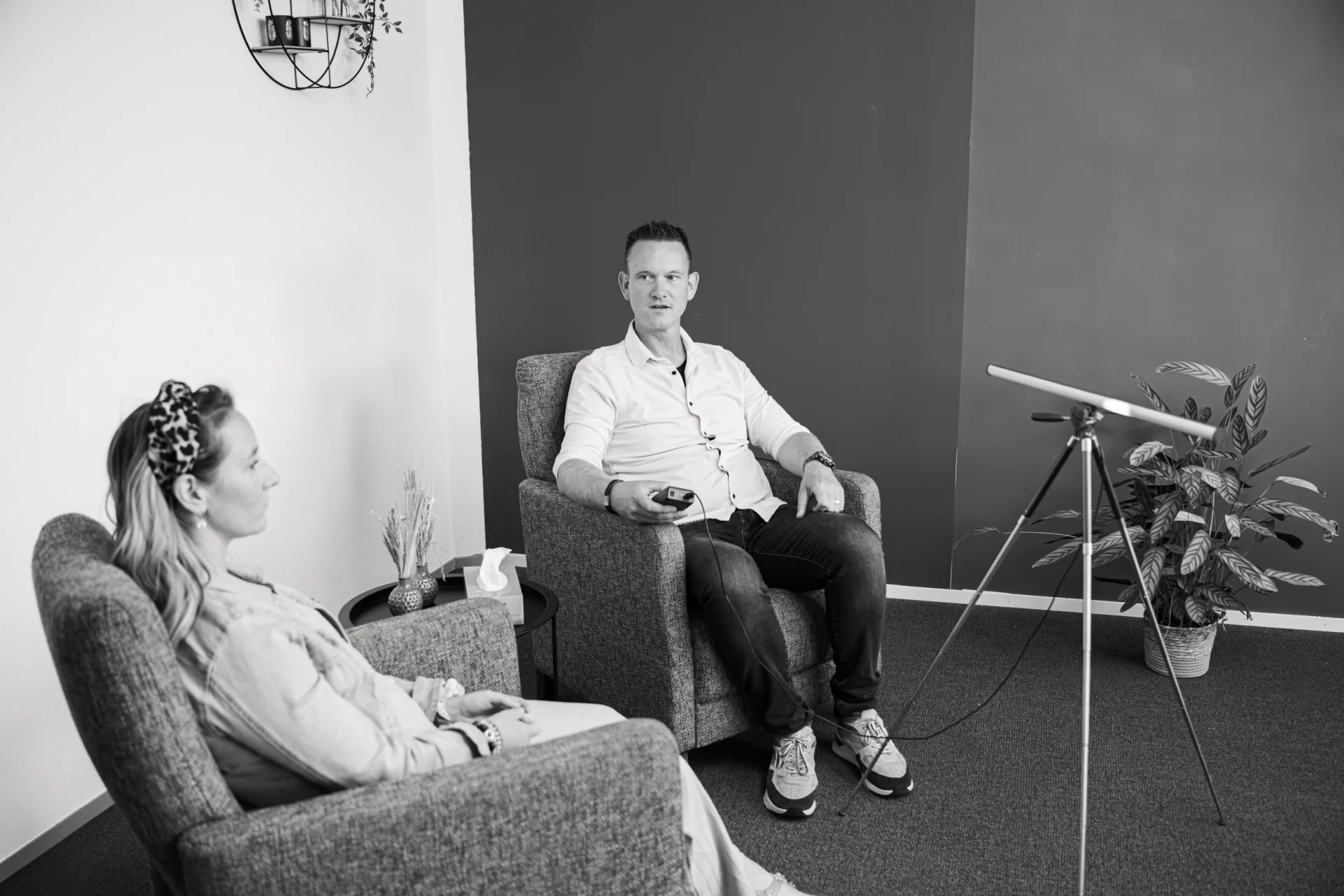
With us, you look at what happened and how it affects you together with one dedicated therapist. We work without diagnoses and without a standard protocol. You determine the pace and how much you want to share. Safety always comes first.
How does the treatment proceed?
- Report. You can sign up via the form, phone, or WhatsApp. There is no waiting list: you can expect an intake within 3 weeks.
- Intake. We discuss what you have been through, what symptoms you are currently experiencing, and what you want to achieve. You don't have to tell all the details right away.
- Tailor-made plan. We make a proposal and provide an estimate of what is needed. You decide whether it suits you.
- Stabilize. Where necessary, we first work on calm and stability, so that you can handle the processing.
- Process. With EMDR or another suitable method, you process memories that still carry emotional charge.
- Complete. Together, we look at what has changed and what you take away to move forward on your own.
EMDR therapy
EMDR therapy EMDR is a recognized treatment for trauma and is listed in the Dutch Mental Health Care guideline for PTSD. EMDR stands for Eye Movement Desensitization and Reprocessing. You recall an unpleasant memory while being distracted, for example by eye movements or taps. As a result, the memory loses its emotional charge. You still know what happened, but it hurts less. A session lasts 60 minutes.
EMDR for children
Children, too, can get stuck after a traumatic experience. They often show this differently than adults, for example through poor sleep, behavioral relapses, stomach aches, or excessive anger. EMDR also works with young children, in a playful way using drawings or a story. Read more about EMDR for children aged 6 to 12 and EMDR for toddlers and preschoolers. We always involve parents in the treatment.
When your body carries the tension
Sometimes trauma resides not so much in memories, but primarily in your body. Think of unexplained symptoms, loss of function, or seizures. With FNS (functional neurological disorder), the brain and body do not work together properly, even though there is no visible damage. Stress and past experiences sometimes play a role in this. In our FNS treatment we look at your complaints and your life story.
The WEEBER® method
With us, trauma processing falls under the WEEBER® method. That is our unique approach, developed from practical experience, which combines multiple forms of therapy in a single session. In this way, we work not only on the memory but also on the patterns and beliefs that have arisen from it.
On location or online
You choose where you receive the treatment: at one of our two practices in Zwaagdijk-Oost or Tuitjenhorn, or online via a secure video connection. Online EMDR works in the same way as in the practice. Even via the screen, we do everything we can to ensure you feel welcome and safe enough to share your story. This means you can also come to us if you live further away.
Experiences with trauma processing
Clients rate JongStressVRIJ a 5.0 out of 66 Google reviews.
Frequently asked questions about trauma processing
How many sessions do I need for trauma processing?
That is difficult to say in advance. We make an assessment during the intake. If it concerns a single, defined event, fewer sessions are often needed than for life-course trauma. If other memories surface during treatment, it may take longer. Ultimately, you decide what you want to get out of it. We evaluate regularly together.
Does EMDR have side effects?
Many people feel tired after a session. The degree of fatigue varies from person to person and from session to session. We recommend resting for a few hours afterward, but you can function normally. A small group experiences some headaches. Both the fatigue and the headache usually disappear within two days. Sometimes there are vivid dreams after a session; this also subsides on its own.
Does online EMDR work just as well?
Yes. With online EMDR, for example, you follow a moving dot on your screen or tap alternately on your knees yourself. The method is the same as in the practice. The only requirement is that you have a quiet, private place where you will not be disturbed. This way, you can come to us from anywhere in the Netherlands, and also from abroad.
Can trauma return after treatment?
A memory that has been processed well usually does not carry the same weight again. You still know what happened, but it no longer affects you as it did before. However, a new, intense event may trigger something else, or another memory may surface that has not yet been addressed. In that case, you can always turn to us again.
Do I have to tell everything about what happened?
No. With EMDR, you do not have to describe the event in detail. It is about briefly recalling the memory, not telling everything out loud. This makes trauma processing less daunting for many people than they initially thought. You decide what you share and at what pace.
What does a trauma psychologist do?
A psychologist specializing in trauma helps you understand the impact an experience has had on you. Afterwards, you work together on processing it, for example using EMDR. With us, you have one dedicated therapist who knows your story. We combine methods where helpful and tailor everything to your specific needs.
Is trauma therapy covered?
JongStressVRIJ is a private practice. Therefore, the treatment is not reimbursed by basic health insurance. No file will be kept with your health insurer. You can find the rates on our page. investment and rates.
Do I need a referral from the GP?
No, you do not need a referral letter. You can register directly with us. There is no waiting list, and you can expect an intake within 3 weeks. If you would like to keep your GP informed, that is of course always possible. Especially if you also have medical complaints, it is advisable to have your GP review your case.