
- Home
- Treatments
- FNS treatment: understanding what your body is telling you
FNS treatment: understanding what your body is telling you
JongStressVRIJ stands for
- Online & on location
- No waiting times, immediate help
- For everyone
- 1 permanent practitioner
Table of contents
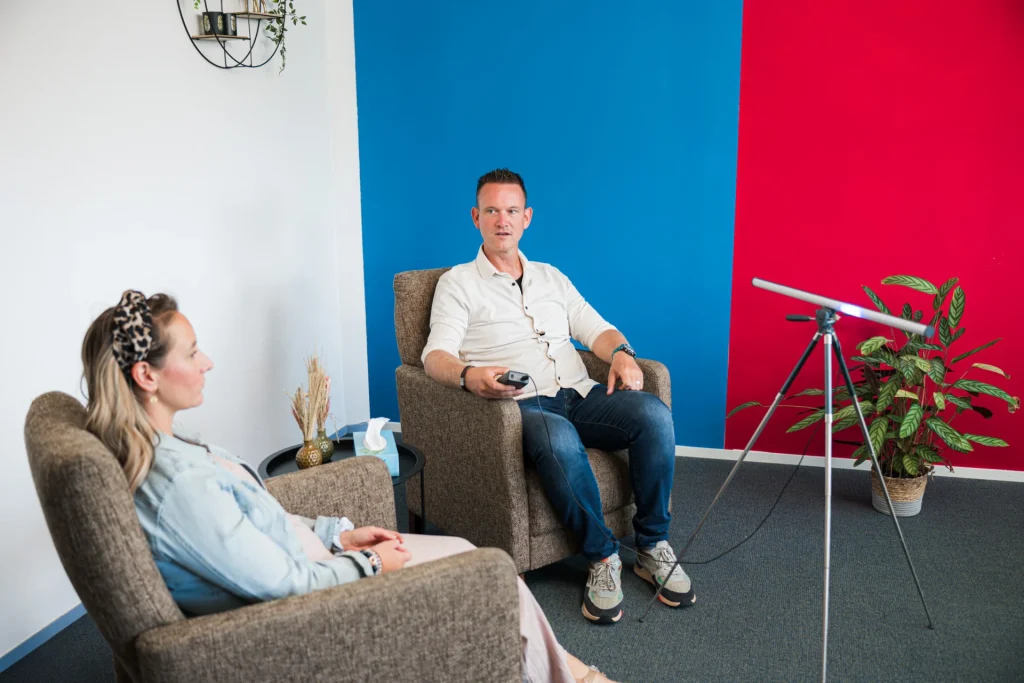
At JongStressVRIJ, we look beyond the complaint.
We look at you as a person, your life story, and what you need to move forward again.
Have you been diagnosed with FNS? Or do you recognize symptoms in yourself such as sudden loss of strength, involuntary movements, weakness, or attacks that you cannot explain? This can raise many questions. Perhaps you do not fully understand what is happening, are worried, or notice that you are becoming increasingly limited in your daily life.
At JongStressVRIJ, we take your concerns seriously. Together, we look at what is going on, which factors might be playing a role, and what can help you regain more control over your body and your life.
Quick start, no waiting time
At JongStressVRIJ, we understand that sometimes help can't wait. That's why you can usually see us for an initial consultation within a few days. You don't need a referral, and there's no lengthy intake process. We create space for you to share your story, without judgment, and together we'll explore what you need to find peace again.
JongStressVRIJ stands for
- Online & on location
- No waiting times, immediate help
- For everyone
- 1 permanent practitioner
What is FNS?
FNS stands for Functional Neurological Disorder. In FNS, the cooperation between the brain and the body does not function properly. As a result, neurological symptoms can arise without there necessarily being visible damage to the brain or nerves.
The symptoms are real. You don't make them up, and you can't simply make them disappear with willpower. FNS can have a major impact on school, sports, friendships, family, and your sense of independence.
FNS can manifest differently in everyone. The symptoms can appear suddenly, vary in severity, or remain present for a longer period.
How do you recognize FNS?
FNS can cause various symptoms, including:
- Movement problems: trembling, shaking, involuntary movements, problems with walking or loss of muscle strength.
- Symptoms of failure: temporarily being unable to move properly or being able to use a part of the body less well.
- Sensory disorders: for example, a numb, tingling, or altered sensation in a body part.
- Functional seizures: attacks in which someone, for example, shakes, loses consciousness, or is temporarily less responsive.
- Problems with speaking, seeing, or hearing: difficulty speaking, swallowing, or processing sensory information.
- Cognitive complaints: problems with concentration, memory, or processing information.
In addition, fatigue, pain, sleep problems, and hypersensitivity to stimuli may occur.
Not everyone with these symptoms has FNS. The diagnosis is made by a doctor, usually a neurologist, based on characteristic symptoms and a neurological examination. New or changing symptoms must be medically reassessed if necessary.
What is an FNS attack?
A functional seizure can manifest as uncontrolled trembling or shaking, stiffening, loss of movement, or temporarily reduced contact with the environment. The seizure is involuntary and is not consciously induced.
The difference with epilepsy is that an epileptic seizure is caused by abnormal electrical activity in the brain. In a functional seizure of FNS, there is a disruption in brain function, without the same electrical discharges as in epilepsy causing the seizure. FNS therefore involves a dysfunction of specific brain regions.
Stress, overload, and traumatic experiences can play a role in some people, but are not always the cause. Functional FNS seizures are genuine physical symptoms and cannot be consciously stopped. A neurologist can help differentiate between functional seizures and epilepsy. However, stress or traumatic events can cause symptoms that resemble FNS.
How do you learn to cope with FNS attacks?
At JongStressVRIJ, we teach clients to better understand and cope with functional attacks. Using the WEEBER method, we map out the life trajectory, investigate potential triggers, and treat impactful events where necessary. Additionally, clients learn to recognize stress signals, regulate tension, and use a signaling plan to take appropriate steps in a timely manner.
Parents receive psychoeducation about functional seizures and learn how to respond calmly, safely, and supportively during and after a seizure. We help parents distinguish between their own emotions and those of their child, set appropriate boundaries, and support their child without unintentionally creating additional tension.
In this way, we work together towards more insight, safety, and trust, with the goal of reducing the impact of the attacks on daily life.
What is the relationship between FNS and mental well-being?
Our body and mental health are interconnected. Prolonged stress, tension, overload, and traumatic experiences can affect how we feel and function. In some people, such factors may also be associated with the onset or persistence of FNS complaints.
That does not mean that FNS is exclusively a psychological problem. Nor does it mean that everyone with FNS has experienced trauma.
For some, prolonged stress and high expectations play a role. For others, experiences of loss, bullying, a sense of insecurity, relationship problems, or difficulty recognizing and expressing emotions may be important. Sometimes, no clear cause can be found.
That is precisely why we believe it is important not to jump to conclusions too quickly. Together with you, we explore which factors may be significant and what is needed to support recovery.
FNS and autism or chronic pain
Yes, FNS can occur in combination with both autism and chronic pain. However, it is important to distinguish between a possible association and a direct causal link.
At JongStressVRIJ, it is therefore important not only to look at FNS complaints, but also at the client's development, sensory processing, physical complaints, stress load, and personal life history. For children, we also take into account the family situation and support provided by parents.
FNS and autism
Research shows that autism is more common in people with FNS than previously thought. Sensory processing, recognizing body signals, and managing emotions may require attention. The precise relationship between autism and FNS is still being investigated.
FNS and chronic pain
FNS can be accompanied by chronic pain, fatigue, and other physical complaints. These symptoms can influence each other and reduce daily capacity. It is important to take physical complaints seriously and have them medically assessed if necessary.
At JongStressVRIJ, we incorporate this interconnectedness into the treatment plan. We look at what the client needs to better regulate stimuli and stress, recognize body signals, and gain more control over daily functioning. In doing so, we tailor the guidance to the individual needs of the client and the family.
How does JongStressVRIJ treat FNS?
Your life story as a starting point
At JongStressVRIJ, we do not work from a standard protocol that is the same for everyone. You are our starting point. We tailor the treatment plan to your symptoms, personality, development, experiences, needs, and goals.
We look not only at what is going wrong now, but also at how you have developed and what you have experienced along the way.
1. A timeline from -9 months to now
In the Treatment Plan (BHP), we map out your life story together. We start with the period before your birth, from approximately nine months prior, and follow your development up to the present.
We investigate important events and experiences, such as:
- The circumstances surrounding your birth and your first years of life.
- The development of your attachment and the relationships with important people around you.
- Experiences at school, within the family, and with peers.
- Major events, loss, bullying, or other experiences that have had a significant impact on you.
- Prolonged stress, high expectations, conflicts, or situations in which you did not feel safe or understood.
- Moments when you have adapted yourself to others, suppressed your feelings, or crossed your own boundaries.
Through conversations, our experience, and targeted psycho-education, we try to recognize patterns and connections together. Sometimes, experiences emerge that you had not previously realized how much influence they had on you.
We proceed with care. Not every event is a trauma, and not every young person with FNS has attachment issues. We explore what is meaningful to you, without establishing a preconceived explanation for your symptoms.
2. Understanding what is going on
Once we have more insight into your life story, we will look at which factors may be contributing to your symptoms or hindering your recovery.
Think, for example, of difficulty regulating emotions, prolonged tension, insecurity, overload, or the feeling of constantly having to meet expectations.
We explain how stress, emotions, physical reactions, and behavior can influence each other. This helps you better understand what is happening and how you can gain influence over certain patterns yourself.
The goal is not to find a cause at all costs, but to discover starting points that can help you.
3. A treatment that suits you
Based on the treatment plan, we choose together which forms of treatment are appropriate. Depending on your needs, this may consist of:
- Trauma treatment: when significant experiences play a role and processing is indicated.
- Attachment-focused therapy: when relational patterns, trust, or experiencing safety are important themes.
- Cognitive behavioral therapy (CBT): to gain insight into thoughts, feelings, and behavior and to develop helpful patterns.
- Emotion regulation: learning to recognize, understand, and manage emotions and physical tension.
- Assertiveness and setting boundaries: learning to express what you need and stand up for yourself.
- Working on self-image and self-confidence: discover who you are, what you can do, and what you need.
- Psycho-education and stress regulation: understand how tension and overload have an impact and learn to deal with signals from your body.
Not every treatment is suitable for everyone. We always assess what aligns with your situation, what you can handle, and what is most helpful at that moment.
In addition, specialized physiotherapy, exercise therapy, rehabilitation care, or other medical guidance may be required for movement problems, functional seizures, or other specific neurological complaints. We consider collaboration with the involved healthcare providers important.
4. No standard protocol, but customization

Everyone has their own history, personality, environment, and way of coping with stress. Therefore, we do not believe in a single fixed treatment approach that works for everyone.
You are our protocol.
This means that we shape the treatment plan together and continue to evaluate it along the way. We look at what works, what you need, and which steps are feasible. Sometimes this requires further in-depth exploration, while at other times it calls for stability, practical support, or strengthening skills for daily living.
We want the treatment to fit into your life, rather than you having to adapt to a fixed treatment program.
FNS in children: the role of parents
In children, development, the environment, and dependence on parents play an important role. Children often have fewer words and skills to recognize and process stress, emotions, and traumatic experiences. As a result, tension can also manifest physically, for example in functional seizures.
At JongStressVRIJ, using the WEEBER method, we look not only at the child but also at the family situation. We map out the timeline and investigate which events, emotions, and stressors may play a role.
Parents are an important part of the treatment. They learn to better understand the symptoms, recognize signs of tension, and respond calmly and supportively during and after an attack. We also pay attention to the parents' own emotions and the dynamics between them. By gaining insight into these aspects, they can better support their child, set appropriate boundaries, and provide more calm and safety.
The goal is to provide both the child and the parents with more insight and practical tools, so that the family can better cope with the symptoms and the child's recovery is supported.
A relapse prevention plan that suits you
Even when symptoms decrease, it is important that you know how to continue taking good care of yourself.
That is why we create a personal relapse prevention plan together. This plan is tailored to your life, personality, interests, and daily environment.
We map out, among other things:
- Which signals indicate that tension is building up in you.
- Which situations or circumstances can throw you off balance.
- What helps you calm down and feel safe.
- How to recognize and set your boundaries.
- Which activities, people, and interests give you energy and pleasure.
- What you can do yourself when symptoms worsen.
- Who you can ask for help and when additional support is needed.
The plan is practical and personal. It must not only be correct on paper, but above all be usable at school, at home, during sports, and in contact with others.
Our goal is for you to learn to understand yourself better, recognize signals sooner, and gain increasing confidence in your own abilities.
FNS and school or work
School and work are an important part of the treatment. We are familiar with reintegration plans from the professional field, and we create such a plan for schools as well.
We are happy to involve the school in this, for example through the Internal Supervisor (IB'er) or the mentor. Sometimes an IB'er or mentor joins a session, often online.
An important part of the reintegration plan is explaining things to the school: how do you connect well with the young person and how do you ensure fewer stimuli? We also look together at how you can talk to peers about FNS. Shame is often a factor, whereas openness actually fosters understanding.
Collaboration with physiotherapy, rehabilitation, and neurologist
We maintain close ties with the medical community and strongly believe in collaboration with other healthcare providers. Our network of external care providers includes a physiotherapist, among others.
You can also come to us alongside or after a rehabilitation program. Please keep in mind, however, that there may be some repetition. Perhaps a timeline has already been created; we will create it again. This allows us to obtain a clear and accurate picture of you. For there is more than FNS: there is also your personality, your interests, your character, and your life experiences.
Experience with FNS: from functional attacks to more control and confidence
A young person came to us with recurring functional seizures that caused a great deal of uncertainty and tension within the family. Together, we mapped out the life trajectory and also examined the family situation and the parents' emotions. With the help of a warning signs plan, the young person learned to recognize tension earlier, and the parents learned to respond calmly and supportively during and after a seizure. As a result, the entire family gained more control and confidence.
Client experience
“I really felt heard during the treatment. I was glad that my complaints were looked at broadly, and not just the FNS symptoms. I also have a closer bond with my parents now.”
A young person contacted JongStressVRIJ due to recurring functional seizures. The seizures had a significant impact on daily life and caused uncertainty and tension within the family. Both the young person and the parents needed clarity regarding the symptoms and tools to cope with them.
Using the WEEBER method, we jointly mapped out the young person's life trajectory. We investigated which significant events, tensions, and emotions might be linked to the complaints. In doing so, we looked not only at the young person but also at the family situation, the emotions of both parents, and the dynamics between them. The way parents dealt with their own emotions and how they reacted to each other proved to be an important focus point in the guidance.
We investigated how tension could arise within the family and how this might influence the young person. This was done without assigning blame: emotions and reactions often stem from involvement, concern, and past experiences. By gaining insight into this, we were able to work towards more calm, clarity, and safety within the family.
In addition, we created an early warning plan. The young person learned to recognize signs of escalating tension earlier and to discover what helps to reduce stress. The parents received psycho-education about functional seizures and learned how to respond calmly, safely, and supportively during and after a seizure. We also focused on recognizing and regulating their own emotions, better attuning their responses as parents, and setting appropriate boundaries.
Gradually, more insight emerged into the complaints and the interplay between personal experiences, emotions, and family dynamics. The family received tools to recognize tensions earlier and to deal with difficult situations differently.
The goal of the treatment was to give both the young person and the parents more control and confidence. By involving both the young person and the family environment in the treatment, we worked towards more calm, safety, and space for recovery in daily life.
Working together on recovery
Living with FNS can be uncertain and frustrating. Perhaps you have already tried a lot, or you feel that others do not understand what you are going through.
At JongStressVRIJ, we listen attentively to your story. We explore what can help you, work on factors that are changeable, and tailor the treatment to your needs.
Recovery is different for everyone. We cannot promise a symptom-free life, but we can work together on gaining more insight, appropriate support, skills, and perspective.
You are more than your symptoms. Together, we explore what you need to move forward again.
Do you want to know what JongStressVRIJ can do for you?
Contact us to discuss what support might be suitable for you or your child.
Costs and reimbursement for FNS treatment
At JongStressVRIJ, we operate as a private practice. This means that our sessions are not reimbursed by health insurers. We made this choice consciously because we want to work without diagnoses, standard protocols, or long waiting times. This way, we keep the therapy truly personal, without anything needing to be recorded in your medical file. You can read about the costs on our investment page.
Want to know more about why we don't work with health insurers and what that means for you? Check out our FAQ page.
Frequently asked questions about FNS
FNS stands for Functional Neurological Disorder. With FNS, the cooperation between the brain and the body does not function properly. As a result, neurological symptoms can arise without there necessarily being visible damage to the brain or nerves.
FNS can cause various symptoms, such as movement problems, neurological deficits, sensory disturbances, functional seizures, problems with speaking, seeing or hearing, and cognitive complaints. Additionally, fatigue, pain, sleep problems, and hypersensitivity to stimuli may occur.
The diagnosis is made by a doctor, usually a neurologist, based on characteristic symptoms and a neurological examination. New or changing symptoms must be medically re-evaluated if necessary.
Our body and our mental health are connected. That does not mean that FNS is exclusively a psychological problem. The symptoms are real. You are not making them up, and you cannot simply make them disappear with willpower.
Prolonged stress, tension, overload, and traumatic experiences can be associated with the onset or persistence of FNS symptoms in some people. This does not mean that everyone with FNS has experienced trauma. Sometimes no clear trigger can be found.
Recovery is different for everyone. We cannot promise a symptom-free life, but we can work together on gaining more insight, appropriate support, skills, and perspective.
Not every treatment is suitable for everyone. Based on the treatment plan, we choose together which forms of treatment are appropriate, such as trauma treatment, attachment-focused therapy, cognitive behavioral therapy, emotion regulation, or psychoeducation. In addition, for movement problems, functional seizures, or other specific neurological complaints, specialized physiotherapy, exercise therapy, rehabilitation care, or other medical guidance may be necessary.
An epileptic seizure is caused by abnormal electrical activity in the brain. In a functional seizure of FNS, there is a disruption in brain function, without the same electrical discharges as in epilepsy causing the seizure. A neurologist can help distinguish between functional seizures and epilepsy.
An FNS trajectory requires a lot of attention. Think of 10 to 15 sessions. This also includes system conversations, and almost always 2 or 3 times. EMDR.
Yes, you can also come to us alongside or after a rehabilitation program. Please keep in mind, however, that there may be some repetition: even if a timeline was created previously, we will create it again. This allows us to obtain a clear and accurate picture of you.
JongStressVRIJ stands for
- Online & on location
- No waiting times, immediate help
- For everyone
- 1 permanent practitioner
GOOGLE REVIEWS
Read our clients' experiences
Curious about the experiences of JongStressVRIJ clients? Read real-life testimonials here and discover how others have found their way to a stress-free life!
 Reviews
Had a very nice conversation about the relationship between me and my little brother and received good tips. During the second meeting, we actually had nothing negative left to say. Very happy with it 😁

I received excellent help and gained valuable insights from it.

CUSTOMERS OF
JongStressVRIJ and Collaborations












FNS treatment at JongStressVRIJ: Help for Everyone
At JongStressVRIJ, you are welcome at our locations in Zwaagdijk (2 locations) and Tuitjenhorn, where we welcome clients from all over North Holland and West Friesland. Whether you come from Alkmaar, Heerhugowaard, Purmerend, Hoorn, Bergen, Den Helder, Castricum, or another place in the region, our team is ready to support you.